Author: Jon Ostrower

  • 787 passes crucial “2C” static test (Update1)

    ZY997wingflex_560.jpg

    EVERETT, Wash., Nov. 30 /PRNewswire-FirstCall/ —
    Boeing (NYSE: BA) today completed the static test necessary to validate
    the side-of-body modification made to the 787 Dreamliner. The company
    expects a full analysis of the test results to be concluded in
    approximately 10 days. A successful test result is needed to clear the
    airplane for its planned first flight next month.

    Boeing successfully completed a critical static test today that re-created the conditions that caused the initial delamination in the 787 stringer caps, multiple sources tell FlightBlogger.

    The test — dubbed “2C” — saw the composite wings of ZY997, Boeing’s static test airframe, flexed to a deflection 18 feet without suffering the delamination first seen in previous testing back in May.

    Today’s 2C test, which exceeded 100% of the loads a 787 would ever encounter in service, is the third and final static test FAA requirement to clear the 787 for its first flight in December.

    While the final data analysis is not yet complete, the successful static test is a significant step forward in validating the modification to the 787’s side-of-body, which wrapped up installation on ZY997 on November 16.

    The first two requirements included the high-blow test, completed in September 2008, and the 1G checkout, which was completed in March 20.

    Sources say Boeing plans to test the 787 wing to ultimate load of 150% in the spring of 2010.

    Boeing was unreachable for comment at the time of publication.

    Photo Credit Boeing (File)

    This post was originally published to the internet between 2007 and 2012. Links, images, and embedded media from that era may no longer function as intended.

    This post originally appeared at Flightglobal.com from 2007 to 2012.

  • Exclusive: Bombardier aims to build 20 CSeries per month

    Mirabel-Expansion.jpgBombardier plans a major expansion of its Mirabel, Québec facility to support an ambitious ramp up that, if required, will see 20 new CSeries aircraft produced a each month by 2016.

    Gary Scott, Bombardier President of commercial aircraft, spoke to Flightglobal at the Dubai Air Show about the plans to “more than double” the size of Mirabel to support production of the CSeries.

    “We’re planning, and have all of our suppliers committed to, a day rate,” says Scott.

    “So we will be prepared to go as high as a day rate, because we think we’ll need to, so 20 airplanes per month. Now can we go higher? Sure. It’ll just take additional investment, but clearly it is going to need a significant production rate,” he adds.

    Currently the facility, which supports CRJ production, is roughly
    700,000 sq ft. and will be expanded by just under 1 million sq. ft. as
    CSeries production gets underway.

    Twenty 100 to 125-seat CS100 and 120 to 149-seat CS300 aircraft per month would be an unprecedented production rate for Bombardier, says Scott. The CRJ200 operated at a one-and-a-half-day rate, the previous production record holder.

    FlightBlogger obtained a conceptual graphic (above) of the CSeries infrastructure development at the Mirabel facility that depicts a multi-stage expansion of the site. Initially planned at a 1.2 million sq. ft. expansion, Scott says that some administration functions, for example, will be combined with those on the CRJ program to make better use of the existing footprint, bringing the expansion to below 1 million sq. feet.

    The planning for consolidation of administrative functions with existing CRJ facilities comes as Bombardier has announced a planned production cut of the CRJ line, though Scott says that the consolidation is “an obvious way to reduce our cost and our footprint.”

    Phase One, currently underway is the construction of the Complete Integrated Aircraft Systems Test Area (CIASTA) that will validate the aircraft systems one year before first flight in 2012.

    Phase Two, says Scott, will include construction of supplier satellite facilities to support wing and engine integration, while Phase Three will see the building of final assembly (Phase Four initially on the chart) bay and pre-flight hangar. Phase Four will establish a paint hangar and delivery center (initially Phase Five) for completed aircraft.

    The conceptual chart also includes a section labeled Phase Six, for final assembly and pre-flight extensions to meet a one-day rate.

    While Scott says the plans for CSeries assembly are not yet finalized, Bombardier has decided to build the CS100 and CS300 on a pulse line, with plans to eventually transitioning to a moving line as processes mature. 

    This post was originally published to the internet between 2007 and 2012. Links, images, and embedded media from that era may no longer function as intended.

    This post originally appeared at Flightglobal.com from 2007 to 2012.

  • Movie Monday – November 30 – Comet to Jo’Burg

    In the ever growing list of “Things Aviation Geeks Love”, combining airline nostalgia, classic route structures, new aircraft, trip reports and complex accident investigations might put this week’s Movie Monday close to the top of my favorites.

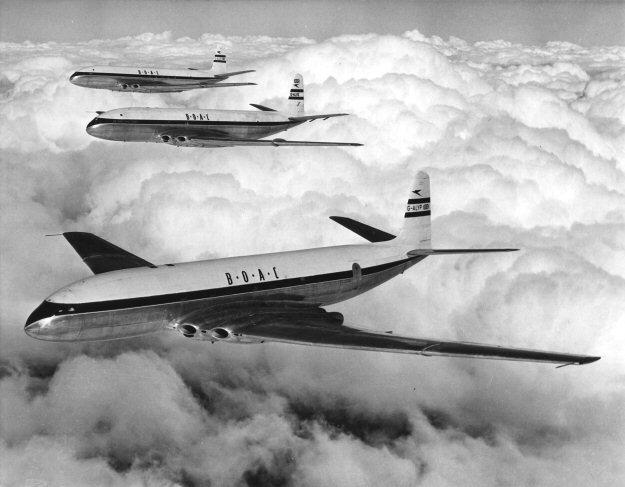
    The first half of this classic news reel from the earliest days of commercial jet travel chronicles the May 1952 London to Johannesburg flight (via Rome, Beirut, Khartoum, Entebbe, Livingstone) of the De Havilland Comet 1 (G-ALYP) on the British Overseas Airways Corporation. Pathe Cameraman Ced. Baynes films the world’s first jet passenger service aboard the square-windowed Comet.

    Flight’s 22 December 1949 Issue discussed the performance of the Comet 1 this way:

    It is officially stated that the Comet has a cruising speed of 490 m.p.h. at an all-up weight of 105,000 lb and, as a 36-seater, a capacity payload of 12,000 lb. With this maximum payload its Still-Air Range (standard atmosphere, no wind, no allowances) is 3,540 statute miles. The corresponding Practical Range is 2,645 miles, i.e., with due allowance for ground running, taxying-out, take-off, climb and descent, navigational errors, airframe and engine variation and deterioration, the Comet with 12,000 1b payload can fly to a point 2,645 miles distant and, on arrival, have sufficient fuel left for 30 minutes of circuits and stand-off prior to approach, landing and taxying in. By reducing the payload to 6,000 lb, the practical range becomes 3,000 miles; with no payload, it becomes 3,220 miles.

    Additional allowances for head wind and diversion to an alternative airport are necessary in order to arrive at the stage lengths that can be operated. For example, the practical range of 2,645 miles with 12,000 lb payload represents a stage length of 2,140 miles, plus 200 miles diversion allowance, all against a head wind of 50 m.p.h. These loadings to 105,000 lb call for a runway length of 2,175 yards, and at this weight the Comet is stated to have a satisfactory three-engine climb gradient.

    The news reel then turns to the loss of that same aircraft (G-ALYP) in 1954 over the Mediterranean Sea as BOAC Flight 781, the first explosive decompression of a Dh.106 Comet aircraft. The investigation that followed saw sister-ship G-ALYU encased in a water tank at Farnborough and repeatedly cycled for the equivalent of 15,000 hours until cracks formed near the corner of an escape hatch due to metal fatigue.

    The investigation update was filmed during the grounding of the Comet fleet and ends on a hopeful note as it looks ahead to the entry into to service of the Comet 2 and Comet 3, aircraft that applied the lessons learned from the loss of the early Comets.

    This post was originally published to the internet between 2007 and 2012. Links, images, and embedded media from that era may no longer function as intended.

    This post originally appeared at Flightglobal.com from 2007 to 2012.

  • Chasing the clues: 787 static tests underway?

    FlightBlogger imageBoeing has publicly said that static testing on ZY997 to validate the 787 wing fix would begin in late November. Well, it’s late November and Matt Cawby’s KPAE blog that closely tracks the goings-on at the company’s Everett facility posted a small item that has attracted quite a bit of attention:

    A wing load test on the static test 787 in the 40-23 began at 4:30 PM
    today and was completed at 7:20 PM. Second test scheduled to begin at
    8:00 PM.

    In this case, “today” referred to Friday, November 27th. Static testing will(is) take(taking) place inside Building 40-23 at the Everett factory, where the static airframe has been parked since April 2008. The static tests will validate Boeing’s side-of-body reinforcement and clear ZA001, the first 787, for flight in Decemeber.

    There are a few other indications that the static tests are underway, but direct (official) confirmation eludes me. Boeing says that they will be making a comment at the conclusion of the static tests, not the commencement, so official word one way or another isn’t coming right now.

    Anyone know what’s up? Is your strain gauge “spidey sense” tingling too?

    This post was originally published to the internet between 2007 and 2012. Links, images, and embedded media from that era may no longer function as intended.

    This post originally appeared at Flightglobal.com from 2007 to 2012.

  • Gulfstream G650 first flight abbreviated after ‘unusual vibration’

    G650_FirstFlight_Aerial_560.jpgG650_FirstFlight_Takeoff_2_560.jpgUPDATE 5:06 PM ET: Gulfstream has put out a formal release on the successful maiden flight of the G650. The vibration that prompted the precautionary landing was centered on a landing gear door.

    UPDATE 2:45 PM ET: Early indications are that the unusual vibration that prompted the early landing was in the aircraft’s flap system.

    UPDATE 2:22 PM ET: N650GA is back on the ground after what is being described by sources as a “unusual vibration”
    caused “precautionary landing” at KSAV around 20 minutes into first flight.

    UPDATE 2:07 PM ET: Two independent reports show N650GA back on the ground at KSAV after “apparently problem” caused “emergency landing”. Working to find details. (NOTE***The landing was never considered an emergency and was deemed precautionary after vibrations in the landing gear door were felt by the crew)

    UPDATE 2:01 PM ET: Savannah Airport weather report:
    METAR KSAV 251853Z 00000KT 10SM FEW070 SCT090 SCT110 OVC180 14/10 A3002 RMK AO2 RAB04E36 SLP165 P0000 T01390100

    UPDATE 1:50 PM ET: Flightaware.com tracking just came alive with a GLF6 flying from KSAV to KSAV as Gulfstream 21 with a departure reported at 1:42 PM ET.

    UPDATE 1:47 PM ET: Source reported at 1:42 PM that N650GA was airborne and first flight of the ultra long-range Gulfstream G650 business jet was underway from Savannah/Hilton Head International Airport.

    UPDATE 1:37 PM ET: Source adds that first flight is now a go at 2 PM ET at KSAV.

    UPDATE 1:25 PM ET: One source says that N650GA’s APU has been started and the crew is going through pre-flight preparations.

    All signs point to Gulfstream flying its flagship G650 early this afternoon at the company’s Savannah, Georgia base, sources tell FlightBlogger.

    The weather has begun to lift and Jake Howard, Tom Horn and flight engineer Bill Osborne may take the G650 (N650GA) into the sky for the first time around 1pm.

    Weather at KSAV shows winds 350@7 kts. with few clouds at 1100 feet and a second broken level at 11000 feet.

    I’m keeping a close watch on flightaware.com and the Savannah Airport Webcam as well, which happens to be pointed directly at the Gulfstream hangars.

    Follow FlightBlogger on Twitter for the latest updates on G650 progress.

    Photo Credit Gulfstream

    This post was originally published to the internet between 2007 and 2012. Links, images, and embedded media from that era may no longer function as intended.

    This post originally appeared at Flightglobal.com from 2007 to 2012.

  • Down to Two: United weighs its widebody options

    FlightBlogger image

    PODCAST: I discuss the United order with Addison Schonland of IAG and Julie Johnsson of the Chicago Tribune.

    Late last week, The Chicago Tribune reported that United Airlines had narrowed its options for the first phase of its wide-body fleet renewal to two choices: The Airbus A350 XWB and Boeing 787 Dreamliner.

    There are pros and cons to the selection of each model, but what cannot be avoided here is the historic relationship between Boeing and United Airlines that finds its roots at origin of both companies.

    Boeing – once named the United Aircraft and Transport Corp. – was split up as part of the Air Mail Act of 1934 that created three separate companies: United Airlines, United Aircraft, the Boeing
    Airplane Co. United Aircraft would later go on to be known as United Technologies, parent company of engine maker Pratt & Whitney.

    The creation of the 727, 737-200 and 767 saw the continued collaboration of these three companies. These new types were powered by Pratt & Whitney engines and launched with orders from United Airlines. In October of 1990, United again served as launch customer for a new Boeing type powered by the P&W engines. The order, which at the time was the largest in commercial aerospace history, was valued at $22 billion and launched the 777 with a firm order for 34 plus 34 options.

    Flash forward 20 years and United again returns to the negotiating table with Boeing on a wide-body order, this time to renew the airline’s fleet (and its image) for the first half of the 21st century. There are a lot of considerations for United to consider when selecting a new fleet, let’s take a look at their remaining options.

    The Case for the A350
    Though an inelegant replacement for the 767-300ER, the A350-800 fits with United’s fleet as a chance to take advantage
    of the trend in up-gauging aircraft while reducing overall capacity. For example, five 244 seat 767-300ER flights can be consolidated into four 270 seat A350-800s. The A350 family
    offers models in the -900 and -1000 that can also replace both the 777-200/200ERs and
    747-400s in a single common platform. The commonality between all three
    variants offers flexibility for United’s pilots, as well as consolidating three wide-body aircraft types into one while streamlining maintenance and operations. 

    Across the Pacific to Australia, United can leap frog over Delta (777-200LR), V Australia (777-300ER) and QANTAS (A380) with the A350-1000 while going from a four engine to a two engine platform with next-generation technology. The investment new United business class interiors suggest that the airline is in no rush to retire its existing wide-body fleet, meaning the 2013-2015 EIS for the A350 family variants makes the timing attractive to coincide with fleet retirement.

    The Case for the 787
    Even with the 787 potentially being overweight, the -8 will offer superior fuel burn performance on same-sized routes currently flown by the 767-300ER by comparison. As the oldest aircraft currently in the fleet, United’s 767-300ERs are the first candidates for retirement. The A350 is too large to act as a suitable replacement for this aircraft. By Airbus’ own admission, the A350 covers the larger 787-9, 777-200ER and 777-300ER market more than the 767 market. The training commonality between the 777 and 787 also offers an advantage for crews transitioning between types.   

    Implementation plans for 787-8 with airlines like QANTAS and Ethiopian have shown these carriers’ intention to deploy the aircraft as a replacement to routes currently flown by 767-300s. Not only can the 787-8 act as a replacement for the 767 fleet for trans-Atlantic routes, but the aircraft could open lower density long-range flights to China, India or Japan. The 787-9 could also replace the 777-200ERs flying with 258 seats on long-haul segments to Asia offering greater efficiency in an optimized platform. The 787-3 in a high-capacity medium haul role also would also be ideal for high-density routes for vacationing travelers to Hawaii from the west coast, acting as a replacement for the older shorter-range 777-200s that fly the routes today.

    The 787 could also be available earlier to United than any A350 variant with the Charleston 787 final assembly line coming online in 2012. While initially sized for three aircraft per month along with Everett’s seven per month, Boeing could hold the surge line in place or potentially boost Charleston to meet the demand of early delivery dates.

    This post was originally published to the internet between 2007 and 2012. Links, images, and embedded media from that era may no longer function as intended.

    This post originally appeared at Flightglobal.com from 2007 to 2012.

  • A Closer Look: Boeing’s new Charleston 787 final assembly line

    787FALCHS.jpg

    I went digging through some US aerospace history today, and if I’m not mistaken, today marks the first time a new commercial jetliner final assembly site has been established in the United States since Lockheed built the L-1011 final assembly line in Palmdale, California in 1968.

    To go along with this massive expansion is a palpable excitement coming
    from Charleston about this new opportunity. The promise of the new
    line, and its potential to transform the city was described by the
    Charleston Post and Courier this way:

    Boeing’s influence likely will reach beyond the plant itself. Planes
    with foreign logos will be lined up on the airport’s tarmac. Students
    in schools will study the aerospace industry within direct sight of
    their future profession. Aviation suppliers will hum with orders to
    support Boeing’s operation. International workers and visitors will
    bring a cosmopolitan flair and flock to cafes and restaurants that will
    spring up to serve the plant.

    “It is rare for a region to get such a gift as a Boeing plant,” said
    Terry Shook, a Charlotte-based urban planning expert.

    Actually, it’s unprecedented. Well, at least since 1967 when the 747-100 line was first built in Everett.

    Today’s ground breaking in North Charleston, South Carolina is certainly the biggest expansion in commercial production capacity Boeing has seen since the company merged with McDonnell Douglas in 1997.

    chsline_445.jpgBoeing released a rendering of the site (featuring 767s?) that depicts a massive final assembly building next to the former Vought 787 plant and Global Aeronautica. The greatly expanded Boeing Charleston site includes six flight line spots, jet blast guards and a heck of a lot of parking.

    I went ahead and took Boeing’s rendering to the next level and applied it to a satellite photo of the existing Charleston facility and came up with the above rendering. The double-wide final assembly building is said to be horseshoe-shaped – like the 777 line – to accomodate pre-integration of all the parts flowing through the building. If nothing else, we might be seeing the worlds largest factory door.

    In case you were wondering, at first glance, S Aviation Ave. looks to be the best place to spot from.

    The line is set to be operational by July 2011 – just 20 months from now – followed by the first 787 delivered from Charleston in the first quarter of 2012.

    This post was originally published to the internet between 2007 and 2012. Links, images, and embedded media from that era may no longer function as intended.

    This post originally appeared at Flightglobal.com from 2007 to 2012.

  • Getting Oriented: Where’s the 787 fleet? Part Three

    ZA001-PH-ASF.jpgUpdating the whereabouts of the now-rapidly-growing 787 fleet has become a regular feature of this blog, and after a week out of the country it’s definitely time to get oriented. So, let’s get this show on the road.

    Test Fleet
    ZA001 is in paint hangar 45-04 going through restoration before it heads to the 40-24 building this weekend. ZA002 wrapped up the wing fix on November 16th and was moved to the 40-24 building for systems restore on the same day. ZA003 has remained in 40-24 (red rudder) where it is undergoing the wing fix. ZA004 is at ATS, where it has been since September 8th. ZA005 has left ATS and joined ZA006 on the flight line. ZY998 (fatigue) was moved from the 40-24 building to the flight line on November 16th and to the Circus Tent on November 17th. ZY997 (static) hasn’t moved an inch since April 25, 2008, but also completed its wing fix on the 16th.

    Production Fleet
    A half-painted ZA100/LN7 has been joined on the flight line by ZA101/LN8. ZA102/LN9 did not pass go, did not collect $200 and went straight to ATS for the wing fix on November 15th. ZA103/LN10, ZA104/LN11, ZA105/LN12 and ZA115/LN13 are in the factory being assembled, with wings and horizontal stabilizer for ZA116/LN14 in the house as well.

    Photo Credit AirShowFan

    This post was originally published to the internet between 2007 and 2012. Links, images, and embedded media from that era may no longer function as intended.

    This post originally appeared at Flightglobal.com from 2007 to 2012.

  • Photos of Note: The 2009 Dubai Air Show

    dubai-header.jpg

    Video originally embedded here

    www.flickr.com
    This Flash-based video is no longer available.

    This post was originally published to the internet between 2007 and 2012. Links, images, and embedded media from that era may no longer function as intended.

    This post originally appeared at Flightglobal.com from 2007 to 2012.

  • Mary Kirby and I review Day Three at #DXB09

    dubai-header.jpg

    This last daily wrap up from Dubai is a tad belated due to some late network issues. We also had to record this one a bit earlier on Tuesday because of some time constraints, so we didn’t get the full skinny on the orders announced during the day. That being said, I’m back safe and sound on the East Coast! Thanks everyone for a very memorable week!

    This post was originally published to the internet between 2007 and 2012. Links, images, and embedded media from that era may no longer function as intended.

    This post originally appeared at Flightglobal.com from 2007 to 2012.