Category: FlightBlogger

  • Analysis: Understanding the new 787 fastener challenge

    787completion.jpgBoeing’s latest delay for the 787 Dreamliner was blamed on a 57-day strike by machinists, but the program’s schedule already faces additional pressure by new disclosures about improperly installed fasteners.

    According to sources across the program, the number of fasteners needing replacement range from about 2,500 to 5,000 per aircraft or shipset. Boeing publicly estimates that less than 3% of fasteners installed to date will have to be removed and reinstalled.

    Boeing underscores that, “the issue is with installation of the fasteners, not the fasteners themselves.”

    Significant engineering and machinist resources across the program are being devoted to solving this problem inside Boeing and structural partner facilities as quickly as possible.

    The challenge to the programme schedule centres on getting fasteners removed and reinstalled, as well as the potential damage to the composite material that could occur.

    “The risk involved is that some of the fastener holes will need to be oversized.  This is a common practice on in-production repairs,” said one veteran engineer.

    “Fastened structure is designed to allow for future reworkability, primarily for in-service repairs.”

    Boeing faced time consuming repairs on Dreamliner One following the July 2007 rollout when temporary fasteners caused damage after being removed to make way for permanent ones.

    Boeing is re-training all 787 machinists in its Everett facility on new fastener installation procedures. Compounding the problem, sources say, is the slow pace of workers returning following the conclusion of the IAM strike. Machinists have until November 10 to return to work, according to the strike resolution. Only machinists who have completed the re-training are permitted to work on the aircraft again.

    Those familiar with the fastener situation tell FlightBlogger that the problem originated in two separate types of fastener installation on the four flight test and two ground test aircraft, as well as the more than a dozen shipsets currently at supplier partners.

    The first problem stems from the holes drilled to affix titanium and carbon fibre together. When holes are drilled into titanium, a burr is often left on the edge of the entry side of the hole. Because of the extraordinary strength of titanium, when a fastener is installed in the hole, the head will sit on the burr rather than flush against the surface.

    With the head of the fastener resting on the burr, the loads will be distributed on that one spot rather than evenly across the surface. In addition, in the event of high side-to-side shear loads, in a worst-case scenario, the high-strength titanium burr could cut the fastener undermining structural integrity.

    Titanium is used in key structural areas of the aircraft such as the joined sections in the fuselage and horizontal stabilizer.

    Sources say the fastener problem was first discovered on the engine pylons on the static test airframe. The pylons have been removed from all aircraft in Everett and returned to Spirit AeroSystems in Wichita, Kansas for repair.

    All major structure partners, with the exception of the wings supplied by Mitsubishi, are impacted by this problem, including Vought, Global Aeronautica and Alenia.

    This post was originally published to the internet between 2007 and 2012. Links, images, and embedded media from that era may no longer function as intended.

    This post originally appeared at Flightglobal.com from 2007 to 2012.

  • Flash: Boeing 787 won’t fly in 2008 (Update2)

    Citing the extended work stoppage of the 57-day IAM strike, Boeing says the 787 Dreamliner will not accomplish its goal of flying by the close of the fourth quarter of 2008.

    Boeing adds that it will not set a new target date for first flight or first delivery while a full assessment of the programme’s post-strike status remains ongoing. Boeing’s last schedule called for delivering the first 787 to launch customers All Nippon Airways in the third quarter of 2009.

    This latest delay is the fifth slip for the first flight of Dreamliner One since September 2007, and suggests the event could occur almost two years after the original schedule target.

    Included in the assessment is a costly manufacturing error. Boeing acknowledges a need to reinstall slightly less than 3% of all fasteners throughout its production system.

    The fix covers about about two dozen shipsets spread all over the world, which include the four flight test and two ground test aircraft currently in Everett, Washington.

    “The issue is with installation of the fasteners, not the fasteners themselves,” Boeing says.

    As a result, the company is conducting a root cause analysis to determine the exact source of the problem. A preliminary examination indicates that unclear specifications for the fasteners resulted in misinterpretations at the time of installation.

    As a result, Boeing is reworking those specifications and supplying the workforce in both Everett and the partner base with additional training to ensure this problem does not repeat itself.

    Boeing is “not aware” of any other installation issues on the aircraft that would require a reassessment.

    The company emphasizes that the 787 programme’s quality control system caught this problem before any non-conforming parts were allowed to fly.

    Boeing says the problem was discovered two weeks ago during a scheduled inspection of the airframe undergoing static testing in Building 40-23 at the Everett facility. As a result of the findings on the static airframe, Boeing began randomly sampling fasteners across the other flight test aircraft and found the problem to be widespread.

    Of those 3% of fasteners, many are either too short or too long. This leads to small gaps beneath the head of the fastener, a design non-conformance requiring reinstallation.

    Although the exact number of fasteners requiring reinstallation was not disclosed, Boeing has said that the 787 uses 80% fewer fasteners than an aluminium aircraft of equivalent size. The 767, slightly smaller than the 787, has roughly 1.8 million fasteners per plane. This estimate could place the number of required fastener reinstallations in the thousands across the programme.

    Boeing emphasizes that no improperly installed fasteners will travel from supplier partners to Everett, minimizing the additional traveled work.

    This post was originally published to the internet between 2007 and 2012. Links, images, and embedded media from that era may no longer function as intended.

    This post originally appeared at Flightglobal.com from 2007 to 2012.

  • No, really. Go vote.

    FlightBlogger image

    No, really. Go vote., originally uploaded by flightblogger.

    Seriously, not messing around here. Vote.

    This post was originally published to the internet between 2007 and 2012. Links, images, and embedded media from that era may no longer function as intended.

    This post originally appeared at Flightglobal.com from 2007 to 2012.

  • Go Vote America

    FlightBlogger image

    Go Vote America, originally uploaded by flightblogger.

    Nuff said. Go vote.

    This post was originally published to the internet between 2007 and 2012. Links, images, and embedded media from that era may no longer function as intended.

    This post originally appeared at Flightglobal.com from 2007 to 2012.

  • Obama and McCain Election Edition Open Thread

    BOJMplanes.jpgBoeing’s Back to Work
    With 100% of union halls reporting, the IAM has voted 74% in favor of the new four-year contract. The strike officially ended last night with the beginning of third shift after 57-days. Analysts estimated $100-120 million in lost revenue daily. This could translate into $5.7 to $6.8 billion in deferred revenue that will eventually be recovered once the delayed aircraft are delivered.

    Oh right, there’s another election on Tuesday…
    Tuesday is ELECTION DAY. Just in case you’ve been in a coma for the last two years, Sen. Barack Obama is the Democratic Nominee and Sen. John McCain is the Republican nominee.

    They’ve got issues
    As far as aerospace and aviation issues go in this campaign, they’ve been pretty low priority on the list. Though here’s a smattering of other people’s assessments of the candidate’s positions and proposals:

    Dollars and cents
    Also a quick look at fundraising data supplied by opensecrets.org shows some interesting contribution trends from aviation related interests:

    contributions.pngThe Air Transport Industry (Eg. airlines, advocacy groups) has donated $368,146 to Sen. Obama and $521,684 to Sen. McCain. The Defense Aerospace Industry (e.g. Lockheed, Boeing, Honeywell) has contributed $251,297 to Obama and $199,144 to McCain.

    Opensecrets.com only has a breakdown of select companies and their
    contributions, which include donations from individuals employed by
    those companies, as well as contributions from their respective
    political action committees. UPS, FedEx, GE, Boeing, Lockheed Martin
    and AMR (American Airlines) are amongst the top contributors to both
    candidates.

    MAKE SURE TO VOTE

    Lastly, make sure to vote tomorrow – November 4th! I’m voting at my local library tomorrow to put some weight behind Washington, D.C.’s 3 electoral votes.

    Where do I cast my ballot? Find out here.
    Don’t know when the polls close? Find out here.

    This post was originally published to the internet between 2007 and 2012. Links, images, and embedded media from that era may no longer function as intended.

    This post originally appeared at Flightglobal.com from 2007 to 2012.

  • Playing with PanoLab for iPhone

    Having way too much fun with this application. The possibilities
    stretch much farther beyond just pictures of my messy desk. The
    ability to stich together a panoramic photograph on location and
    upload it directly to the blog has some exciting potential.

    This post was originally published to the internet between 2007 and 2012. Links, images, and embedded media from that era may no longer function as intended.

    This post originally appeared at Flightglobal.com from 2007 to 2012.

  • Boeing: Dreamliner Brakes A’Okay

    DSC_0192.jpgI’m always a big fan when blogs break news, so I enjoyed FleetBuzz Editorial reporting that 787s brake control software was no longer an issue.

    “The issues with the brake software are behind us, functionality required for flight test is in the labs and is working well. (The final “blue label” version — for flight test — is in the lab and is undergoing tests, all known software problems are resolved. The formal “red label” version will follow in two weeks. We plan on a service-ready update during flight test that adds some additional functionality including tire pressure, operator initiated test, and dataload),” said 787 spokeswoman Yvonne Leach.

    The electric brake control software was cited over the summer by program VP Pat Shanahan as one of the key pacing items for the aircraft. The software for the control system is supplied by subcontactor Crane.

    Back in July, when the last official program update was provided, Shanahan said four items were still remaining before first flight could happen.

    1. Complete Dreamliner One
    2. High-blow test – COMPLETE
    3. Limit load tests on the leading and trailing edges – Boeing says an announcement will be made when these tests are completed
    4. Ground vibration tests on Dreamliner Two

    Question: What’s up with Dreamliner One? Let me know: flightblogger (at) gmail (dot) com

    This post was originally published to the internet between 2007 and 2012. Links, images, and embedded media from that era may no longer function as intended.

    This post originally appeared at Flightglobal.com from 2007 to 2012.

  • The big value of small national airlines

    Surinam747300.jpgThis piece is cross-posted at the Adventure Quest travel blog

    The question was raised on a travel blog earlier this week about the necessity for small countries to operate airlines of their own. The question of justification came to the fore when looking at Surinam Airways, an unlikely country to have an airline, and whether or not a country with a gross domestic product of $2.4b should have (or needs) an airline of its own.

    For nations large and small, rich and poor, civil aviation has been a vital tool to connect citizens with the world on its own terms.

    “International aviation is thus not just another problem in a changing economic system, though it is that; international civil aviation is a serious problem in international relations, affecting the way governments view one another, the way individual citizens view their own foreign countries, and in a variety of direct and indirect connections and the security arrangements by which we live.” – Andreas Lowenfeld

    That quote, from a 1975 article in Foreign Affairs Magazine, inspired my senior thesis in College. The title was Aviation as Ambassador, not coincidentally the same name of the first post on FlightBlogger in 2007.

    The historical Western global leadership in civil aviation in the first half of the last century has served as an example to all nations as a symbol of modernization and progress.

    Civil aircraft (in both their development and operation) are symbols of power and prestige for nations. We need only look to the Boeing 747 and Airbus A380 to see the impact these aircraft have had on the identity of the nations that operate them.

    For the United States, the same year Charles Lindbergh flew non-stop from New York to Paris in 1927 (contrary to popular belief he was not the first to cross the Atlantic) Pan American Airways came into being as an airmail service between the Florida Keys and Havana, Cuba. With the relative protection of the US Government, which saw Pan Am as the “chosen instrument” for US travel abroad, the airline quickly became America’s flag carrier. Later on in the century, Pan Am would become Boeing’s launch customer for the 747.

    The idea of a flag carrier in the US is somewhat outmoded though. Pan Am folded in 1991 and TWA in 2001 (merging with American Airlines). Today, we have Delta/Northwest, United, Continental, American and US Airways – so the idea of one airline representing the US abroad is foreign to Americans.

    In the case of the US today, international air travel is a representation of the free market forces that enable such competition, multiple airlines competing with one another vying for the attention of the consumer. In the absence of one flag carrier, we find the identity of the United States. Though protectionist tendencies still abound with restrictions on foreign ownership and cabotage.

    These same political motivations created (and protected) the airlines of the world’s largest economies; Pan Am (defunct), Lufthansa, British Airways, Air France and others are also found in smaller countries like Surinam.

    For airlines like Surinam Airways, which operates a fleet of two aircraft, connecting its citizens to the world is an important representation of self-determination and modernization; profitability and operational effectiveness often falls by the wayside.

    There are two sides to this coin. A national airline can carry both a positive and negative message about a country. As an extension of national identity, airlines can become a liability  in the event of an accident. Accident prone airlines like Garuda and other Indonesian carriers have found themselves blacklisted by the EU, unable to serve Europe causing  significant damage to the economic health of the nation.

    Surinam Airways was founded in 1955 and became the national carrier when Surinam gained independence from the Netherlands in 1975. Today, the airline operates one Boeing 747-300 and McDonnell Douglas MD-82, both built in 1986 for long haul and regional routes respectively serving seven destinations in Europe, North America, the Carribean and South America.

    The airline is as much a tool of economic development and tourism as much as it is a diplomatic symbol of Surinam touching down in countries around the world.

    For the nations that don’t hold significant economic sway, aviation is ambassador.

    Photo credit: Pascalg_1991/Creative Commons License

    This post was originally published to the internet between 2007 and 2012. Links, images, and embedded media from that era may no longer function as intended.

    This post originally appeared at Flightglobal.com from 2007 to 2012.

  • Reading Boeing’s Tea Leaves

    This day deserves a round up of all the Boeing news that is currently making me cross-eyed.

    Boeing and the IAM are cited as one of four causes for economic slowdown in the US by the White House:

    “Today’s G.D.P. report is weak, but it is not unexpected,” a White
    House spokeswoman Dana M. Perino. “A number of things contributed to
    the slowing economy in the third quarter — record high energy prices,
    housing and credit concerns, two major hurricanes and a prolonged Boeing strike.

    Boeing released a podcast this afternoon (props to TBC on the new media!) and made some significant news with its content. MIke Denton, VP of Engineering says that Boeing is insourcing significant detailed design work for 787-9.

    One of the really important things that our teams need to know is that we have learned as a management team from the lessons of the 787-8. so the way we do the -9 in terms of how the design work is shared between partners and the Boeing company will be revised.

    So the end result of that is that we had a fair bit of incomplete build and incomplete design and a lot of traveled work that came to our factories here in Everett Washington. And our engineers and production workers are basically correcting the problems that should have never come to us in the first place. Problems that are the result of the partners really not being done. That’s really unfortunate.

    We will do more of the detailed design work on the 787-9 than we did on
    the -8. We are working out those details with some of our affected
    partners now. For the next new airplane and the bright future is there
    will be a next new airplane we will look at how the partner model went
    on the 787.

    The podcast itself is a significant mea culpa on the issues with the 787 program in acknowledging what went wrong and where. Though the biggest play is to throw a significant carrot to SPEEA whose biggest grievance has been the continued outsouring of engineering work to risk sharing partners and engineering centers outside the US.

    READ THE FULL PODCAST TRANSCRIPT

    Shot:

    Denton: The challenges for SPEEA and our working with them is that — just as we have new leaders in the Boeing side in Doug Kight and Tom Easley — the SPEAA team is represented by a new executive director. So part of successful negotiation is establishing a good working relationship. So right now we are in the process of developing that relationship and defining the new norms for how we’ll do our negotiating.

    Chaser:

    From @SPEEA at 6:46 PM ET 10/30: SPEEA ends today’s meeting early citing Boeing intransigence

    ATW reports today that Jetstar is expecting an additional six-month delay on getting its first 787.

    QANTAS’ low cost arm is expecting Ship 21 in November 2009, but that, according to the airline, appears unlikely. An additional six month slip for early customers could put the first delivery to ANA as far out as February 2010, assuming August 15, 2009 as the current delivery date.

    Jetstar Airways executives told ATWOnline this week that the LCC’s first 787 is not expected until May 2010, 21 months later than the original schedule. A spokesperson added, “Based on what we have been told, we are working on contingencies and planning for a further three-to-six-month delay in our delivery, although Boeing is yet to formally confirm that.” The lag is far longer than the 54-day IAM strike and confirms ATWOnline’s report last month that there has been further slippage in the program, possibly due to brake control issues.

    Also, Ethiopian news site Nazret.com cites a Reuters report from Addis Ababa that Ethiopian Airlines is expecting its first 787 by the end of next year:

    It already has 10 Boeing Co 787 aircraft on order, the first of which
    is now due to be delivered in December 2009, after supply chain
    problems delayed the programme by at least 16 months. The airline is
    looking to order more Boeing 787 aircrafts or order Airbus A350 XWB.

    A picture begins to emerge of the (existing) 2009 delivery schedule for the first 25 units based on published reports. These targets are all likely to slip in to 2010.

    ANA – ZA007 – August 2009
    JAL – ZA020 – October 2009
    Jetstar – ZA021 – November 2009
    Air India – ZA025 – November 2009
    Ethiopian – ZA026 – December 2009

    And finally this from Flight:

    Boeing’s finance unit may raise a $5 billion warchest that could be
    used to buy aircraft for leasing, to make loans to customers or to fund
    acquisitions of other businesses.

    The most likely use of these funds would be for financing aircraft purchases in the year to come.

    If we stretch the speculative imagination a bit, these same funds could be used to buy out Alenia on the 2nd half of Global Aeronautica in Charleston. There are loud rumblings that an acquisition could provide Boeing additional stability for the 787 production ramp up. The first 50% from Vought cost about $47 million. $5B would easily cover the remaining 50%. What about expansion of San Antonio? After all there was this item from yesterday’s Seattle Times:

    [The new IAM contract] gives the union a new right to bid for work being considered for transfer to a nonunion Boeing facility.

    This could become important if, say, Boeing decided it wanted to
    move more 787 work to San Antonio, Texas — a nonunion location already
    assigned to do any necessary changes on some of the early production
    airplanes.

    Thoughts?

    This post was originally published to the internet between 2007 and 2012. Links, images, and embedded media from that era may no longer function as intended.

    This post originally appeared at Flightglobal.com from 2007 to 2012.
  • October A380 Production Movements

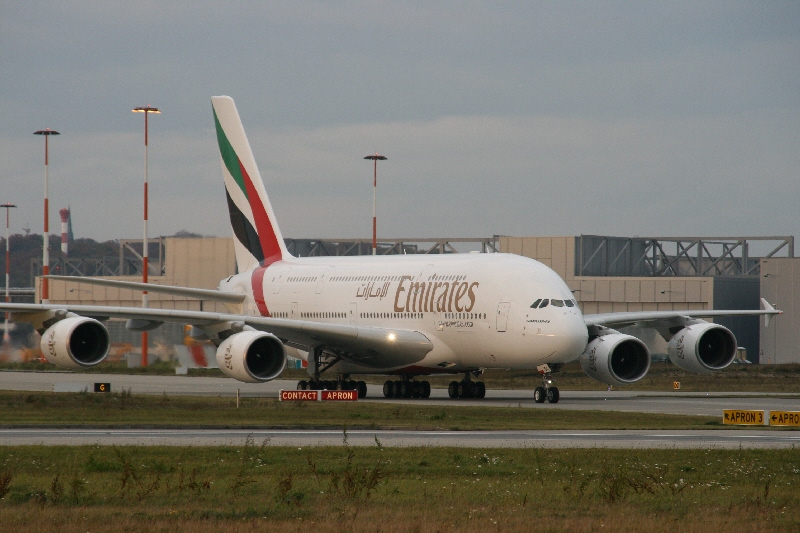
    MSN026tlsoct08.jpgWith the help of A380 spotter Sean Taylor, I put together this rundown of key October movements for superjumbo production.

    In Service

    • MSN014 (VH-OQA) No. 1 for QANTAS entered commercial service on October 20 between MEL and LAX as QF93 and October 24 between SYD and LAX.
    • MSN013 (A6-EDB) No. 2 for Emirates was delivered from XFW as EK7380 at 07:25 on October 24.

    In Toulouse

    • MSN021 (F-WWSQ) for Singapore Airlines was spotted on the flight line with engines fitted at TLS on October 24.
    • MSN026 (F-WWSX/VH-OQD) for No. 4 for QANTAS arrived on the flight line with engines fitted at TLS on October 24. This aircraft is the first Wave 2 A380 to have production standard wiring.
    • MSN019 (F-WWSP/9V-SKG) for No. 7 Singapore will be the next A380 to fly at TLS. The aircraft was seen taxiing for the first time on October 27.

    In Hamburg

    • MSN016 (D-AXAC/A6-EDC) No. 3 for Emirates conducted taxi tests at XFW on October 28. Delivery is expected in November.
    • MSN015 (VH-OQB) No. 2 for QANTAS undergoing interior outfitting since June 25. Delivery is expected in December.
    • MSN020 (A6-EDE) No. 4 for Emirates undergoing interior outfitting since July 16. Delivery is expected in December.
    • MSN022 (VH-OQC) No. 3 for QANTAS undergoing interior outfitting since August 4. Delivery is expected in December.
    • MSN017 (F-WWSN) No. 5 for Emirates was transferred to XFW on October 7.

    Photo Credit: David Barrie – MSN026 – Toulouse

    This post was originally published to the internet between 2007 and 2012. Links, images, and embedded media from that era may no longer function as intended.

    This post originally appeared at Flightglobal.com from 2007 to 2012.